Showing posts with label code - SN. Show all posts

Saturday, 1 February 2014

Two more Napoleonic units - British and Spanish infantry


I think both of these units may be Der Kriegspieler figures - I painted and based them quite a while ago and have only just got round to photographng them. When I feel brave I may get the Green Stuff out and have a go at adding greatcoats to some command figures for the British. The Spanish officers are from Douglas Miniatures - not a very good photo I am afraid.

I do have a large number of Spanish and Portuguese infantry battalions which I have acquired and which are waiting painting - the Portuguese are eight line and two cacadores battalions, all Hinton Hunt, with a third Der Kriegspieler cacadore battalion; and four and a half Hinton and three Douglas Spanish line battalions. It may be a while until I get round to these, but it will beef up all my Portuguese brigades in British Divisions to full strength, and bring my Spanish contingent up to one and a half strong or two weak divisions.

Wednesday, 28 December 2011

Peninsular early war cavalry


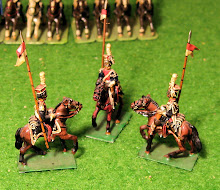
A long time following the last post, here is my completed Peninsular early war cavalry division (minus artillery and command, yet to be assigned - the Heavies will be Ponsonby's, I'm undecided about the lights - probably it will have to be Stapleton Cotton.

The Heavies are missing plumes, which seems right for campaigning, and the Spanish Dragoons are I think a conversion of the Austrian Chevauleger with a bicorned head, which have then been cast up.

I have always wondered why the rule for British Napoleonic ranges has been for them almost always to be in Belgic shakoes for the infantry and foot gunners, bell topped shakoes for light dragoons, and helmets for heavy cavalry. This tends to mean even where earlier war figures were produced, they have far fewer poses or variations, and are far harder to come by.

Stovepipe infantry, tarletoned light dragoons and bicorned heavies are far more versatile, so I am glad to have been able to add these early cavalry. I have two and a half battalions of stovepipe infantry which are the next in line for painting - that will give me 6 battalions in stovepipe, plus a battalion of marines and a naval landing party, supported by four battalions of sepoys, for my early war expeditionary forces. they also have access to vast numbers of horse artillery plus

Tuesday, 22 June 2010

The Battle of the Bernebeu

This last weekend saw among other things (see siege warfare posts on Vintage Wargaming here) an outing for my Spanish and Portuguese Hinton Hunts (along with ox-drawn horse artillery, mules and ox carts). We were using Tony's hex based and computer managed Napoleonic rules, and Italian, Spanish, French, Brunswick and British units from Tony's army.

A slideshow from the battle is posted on the Old Metal Detector here.

Thursday, 25 March 2010

Identity Crisis


A few weeks ago I discovered an ECW Parliamentarian dismounted general in a batch of figures I had thought were all S Range.

For the last 9 months or so I have been wearing a knee length plastic aircast boot on my left foot because of a condition called Charcot's Foot. This has always sounded like it should be an ECW regiment so in celebration of starting to gradually getting out of the cast and back to shoes over the next four weeks or so, I decided to paint up my (very small) total of Hinton Hunt ECW figures - four Parliamentarian dragoons, three Parliamentarian and one Royalist musketeers, and three gunners with one master gunner.

A flying visit by Tony led to the suggestion that the general might also provide a potential command figure for my massed Spanish guerrillas, so here he is in both contexts. What do you think?


Wednesday, 27 January 2010

Spanish Horse Artillery


Long story here - I wanted a Spanish gun crew to support my (growing) Spanish Brigade. I had a spare Minifigs 20mm Austrian gun crew in bicorns and a generic Scruby officer to hand. As the Spanish artillery went over to French-style shakos by regulation of 1812 this seemed the best option - I may cobble together a crew in shakos later - as I aim generally for 1812 as this gives the option of using pre- and post- 1812 uniforms together, allowing for difficulties in supply.

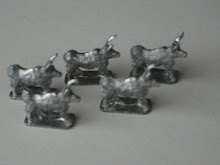
The Austrians have short tailed coats, which make them more suitable as horse rather than foot artillery for the Spanish. However, I wanted a suitably chaotic extemporised limber and team, so have ended up with two Hinton Hunt oxen (H41 Portuguese long horned oxen) pulling a Hinton Hunt French limber AL 3, using a Jacklex oxen yoke. The gun is from Newline (French 6-pdr) and has been done, like the limber, as unpainted wood.The whole thing is topped off by a SN 51 muleteer (the Spanish used civilian drivers). The oxen are David Clayton castings and the muleteer is an original Hinton Hunt one.

The whole set up is a bit impressionistic but I hope is suitably characterful.

Sunday, 10 January 2010

Spanish Reinforcements


Recent reinforcements have arrived which will bring my Spanish regulars up to full brigade strength, with two line battalions and a light battalion.

The pictures are of the reinforcements fresh from painting. The light infantry are Der Kriegspieler 240 Light Infantry Battalion firing - otherwise Hinton Hunt SN 5 line infantry firing sans bayonets; the officer is a PTN 6 Portuguese Officer marching painted to match.

The line infantry figures are David Clayton castings of SN 7 Private marching.

I am also waiting reinforcements for my guerillas, which will bring them up to around 50 strong, plus my 9 muleteers with carts and mules. I have three general officers and a colonel from Rose Wellington figures (previously posted) and I am wondering about using some Minifigs 20mm Austrian artillerymen to approximate Spanish gunners to provide a supporting battery - not sure what guns to use, maybe Newline British or French 6 pounders. I do have two NapoleoN Spanish gun crews, they are nice figures but I am not 100% happy with the match, so maybe less accurate uniform detail but more compatible build may be preferable.

I have some Der K Portuguese Cacadores reinforcements too, more of these later when finished.

Saturday, 28 November 2009

Iberian Contingent - Spanish Line infantry reinforcement


A swap deal has seen (among other things) some Minifigs S Range Line Infantry figures leave me and be replaced with some original Hinton Hunt Spanish line infantry castings. These are now awaiting further reinforcement from another source by some David Clayton marching compatriots, and some Der Kriegspieler Spanish Light Infantry. I have not seen these light infantry figures and will be interested to see which unit they represent, and how they are uniformed.

This should leave result in a reasonably strong three battalion brigade, supported by a large number of guerillas, with carts, mules and muleteers.

Friday, 27 November 2009

Iberian Contingent - muleteer reinforcements


From two sources (Jack and Tony) my Iberian transport train has received significant reinforcement, with the addition of a further ox cart, and both original and David Clayton castings of SN 51, together with another couple of figures previously unpainted from my collection. Through a swap with Jack involving some David Clayton Austrian castings, I have also acquired a further seven H41 Portuguese Long horned oxen and two further H 46 Mules with panniers. All in all my Corps of Muleteers should be busy.

Thursday, 5 November 2009

Iberian Contingent

Ever since reading C.S Forester's Death to the French, the Peninsular Campaign has been my primary interest for the Napoleonic period. After completing the Prussian contingent, my thoughts turned to what to do next, as a quieter time with work has given me a bit more time to paint. The contingent approach seems to offer the satisfaction of completing something, in reasonable manageable chunks, - so long as I leave the British and French out of it for the moment - so I fixed on the Iberians, the Portuguese and Spanish allied force.


I had already completed around 30 Spanish Guerillas (mainly David Clayton castings) and 12 line infantry (original castings), together with a marching Portuguese officer painted as Spanish. I had some further David Clayton castings (a more recent acquisition) and still have unpainted three original figures, including two further muleteers. I also had two painted muleteers and two mule teams. The set up is completed by a mounted colonel, a field marshal, lieutenant general and brigadier from the old Rose Wellington figure, of which I have around 30. This seems to be an appropriate command element for fourty or so line and and thirty or so guerillas! I am currently hopeful of secuting a further 12 Spanish Line (David Clayton) and 18 Der Kriegspieler Spanish Light infantry, which would give me a brigade of three weak battalions. Cavalry and artillery cover will need to be provided by the British.


On the Portuguese front I had the Der Kriegspieler battallion already posted here (whichhad packs added to give them a different look. I was surprised to see I had based these in sixes, rather than threes as is my normal practice for British and allies - I will probably rebase this battalion. I also had acquired two further battalions from Tony, which he had replaced with other figures. These had been painted in a Plaka blue in the 70s, and as this did not match my existing battalion and I had some additional figures to add and paint, I hdecided to repaint the blue on these figures. This has now been completed. I only have 6 original Cacadores (I am currently hoping to acquire some Der Kriegspielers which would complete a battalion) - also have some S Range figures in barretina which will be posted shortly on the Lone S Ranger. So at the moment I have a brigade of three line battalions and a scattering of cacadores; eventually I hope to have a brigade of two line and one cacadores, representing Collins' Portuguese Brigade in the 7th Division, and a reserve independent line battalion. The Portugues contingent is completed by an ox cart.

Iberian Contingent - Spanish forces


The generals aren't pictured here, just the line infantry, guerillas and mule supply teams.

Iberian Contingent - Spanish Line infantry


These two photographs show my current Spanish line infantry forces. They form either one strong or two weak battalions. The top picture shows David Clayton castings (with bayonets), two original Hinton Hunt officer figures and a mounted colonel made from a very early Rose 20mm figure of the Duke of Wellington (see also post below on Spanish Generals). The grenadier company (red plumes) are original Hinton Hunt castings.

The second picture shows original Hinton Hunt figures (minus bayonets) accompanied by a marching Portuguese officer painted as Spanish. I am well supplied with charging Portuguese officers but short of these, so in due course he may return to his true colours and be replaced by a charging colleague. (The Spanish and Portuguese officers are most easily distinguished by the shoulder belt - if it's there he's Portuguese.)
It's also interesting (I think) to note that the original Hinton Hunt Spanish infantry figures have a wooden cylindrical canteen while on the Clayton figures these have been flattened into a water bottle.

I am hoping to secure in the near future some reinforcements of 12 David Clayton marching figures and 18 Der Kriegspieler Spanish light infantry - I haven't seen these or a picture of them, so am not sure what to expect. This would then enable me to field a weak brigade plus guerrillas.

Iberian Contingent - Spanish Guerillas


These are David Clayton castings. I have a further three., original Hinton Hunt, figures to paint, including two muleteers, one of whom will take charge of the Portuguese ox cart.

Iberian Contingent - mule teams

Thursday, 17 July 2008

Sweden

The original catalogue description states:

Sweden played a significant part in the Napoleonic Wars, giving a good account of themselves under the leadership of Bernadotte, whom the French regarded as a truncoat!

Monday, 14 July 2008

Spain 1812-15

The original catalogue descriptions states:

Spanish Infantry of the Line 1812-15

The Spanish Infantry uniformed rather in the style of the British wore the "stove pipe shako", a dark blue coatee with sky-blue trousers.

Spanish Guerillas

The Guerillas were undoubtedly Spain's most potent weapon against the French, making communications costly and difficult and harrying the enemy at all times.